Kazakhstani IT companies to get support in entering international markets
KAZAKHSTANI IT COMPANIES TO GET SUPPORT IN ENTERING INTERNATIONAL MARKETS
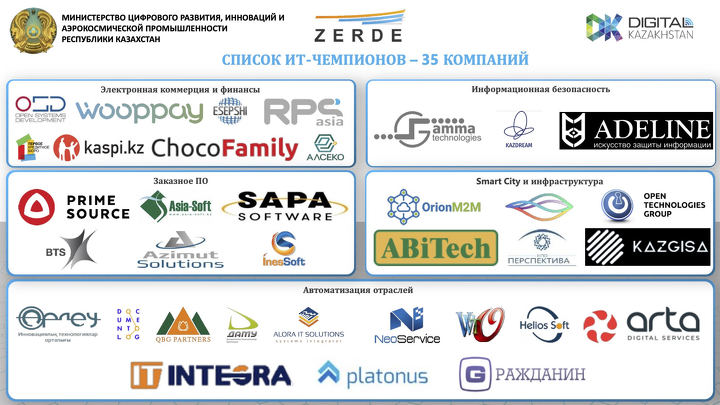
Kazakhstan plans to launch a program to support successful domestic companies in the field of IT. Thirty-five champions that meet all the selection criteria will receive state support. The list will be refreshed every year, giving companies that missed out earlier an incentive to try again. Maksatbek Turan, Director of the ICT Industry Development Department at Zerde National Infocommunication Holding JSC, told us more about the work under way.

— Maksatbek, tell us: how did you arrive at the decision to help successful IT companies promote themselves abroad?
— The state has set itself the task of diversifying the economy: we are moving away from dependence on raw materials and channeling our efforts into creating and promoting new, promising industries. The Ministry of Digital Development, Innovations and Aerospace Industry of Kazakhstan, and we at Zerde National Infocommunication Holding JSC, see great prospects precisely in IT and want to increase the IT market's share of Kazakhstan's GDP. The only effective way to achieve that is to go beyond the country's borders, because our IT market is limited: at the moment it is worth just over $2 billion (according to IDC). Having studied domestic developments, we realized that our companies have great potential on the international market.
— How long have the IT champions been on the Kazakhstani market on average?
— On average they have been working on the domestic market for about 10 years. They realize that the home market is too small for them and are taking steps towards international customers on their own. Today the country earns some $20 million from exports of IT services. Notably, the champions we have selected account for a significant part of that. It is commendable that companies are moving forward without state involvement. But potential customers in other countries always want a reference, and when they are approached simply by company representatives, doubts may arise. When the initiative comes from the state, on behalf of the government, that acts as a guarantee of quality and multiplies the chances of success.
— What did you look at when you were drawing up the list of the best?
— First of all we studied international experience and looked at similar IT programs in developed countries. We observed what they focus on when assessing innovation potential. Based on that experience we drew up 12 criteria. The main ones are at least three years on the Kazakhstani market, tax payments of at least 50 million tenge a year and annual revenue above 200,000 MCI (the monthly calculation index used as a benchmark unit in Kazakhstan). Export potential, or at least export plans, matters enormously, because there are fairly large companies that feel comfortable on the domestic market and have no plans to venture beyond it for now.
— Tell us, in what cases can a company drop off this list?
— The planned program will become a permanent support instrument. The list of companies will be updated annually, and it may contain 20 companies or 50. It is important to understand that the state has an interest in increasing the number of large, stable companies that contribute to the economy. If the criteria I have listed are breached, we will have no choice but to remove the company. In addition, if a company's reputation on the domestic market has suffered, we will not help it expand internationally.
— What are the main financial and non-financial support measures you plan to provide?
— Many companies have promising innovative projects that need nothing more than smart investment. We plan to help them attract such support both through national companies and through our own negotiations. Beyond investing in the products, foreign investors will help our teams develop them and promote them on the international market. We plan to organize a road tour of several countries led by Minister Askar Zhumagaliyev. We have done something similar before: last year we travelled to Uzbekistan, Kyrgyzstan and Russia, where IT companies were able to sign commercial contracts, so we consider this approach very promising. We are also selecting an acceleration program for our champions on the basis of Astana Hub. Unlike start-up tracks, however, the approach will be tailored to each company rather than one-size-fits-all.

— Maksatbek, tell us which countries' markets you are targeting.
— The leading investor countries in the world are, of course, the USA, Japan, China and the United Kingdom. But the companies' own goals have to be taken into account as well. Asia soft, for example, works on the Kyrgyz market, Platonus in Uzbekistan, and Documentolog has opened a representative office in the UAE. Some companies are looking towards South-East Asia, at countries such as Indonesia and Malaysia. These regions have demand for products in financial technology, security and the Internet of Things.
— What features do you think could interest foreign customers?
— Frankly speaking, we understand that nobody is waiting for us on the international market or will greet us with open arms. So, in order to genuinely attract new customers, products have to be built to a high standard, differ substantially from comparable solutions and be more attractive in price. Prime Source, for instance, which provides services to financial institutions, and to banks in particular, does business in Russia. Recently American banks have taken an interest in its solutions, and that is because its products are genuine know-how in this field.
— What work is being done with the companies at the moment?
— Right now the management of Zerde Holding and the Ministry of Digital Development are holding individual meetings with representatives of IT companies. We discuss plans, set goals and identify problems that need to be resolved. We also pay close attention to selecting their IT solutions. A company may have 5-10 products, but only two of them, say, have real potential, and those are the ones we will focus on. In the course of this work it turned out that some companies have a lot in common and can complement each other. That is why we also see potential in consortia when entering the international market.